
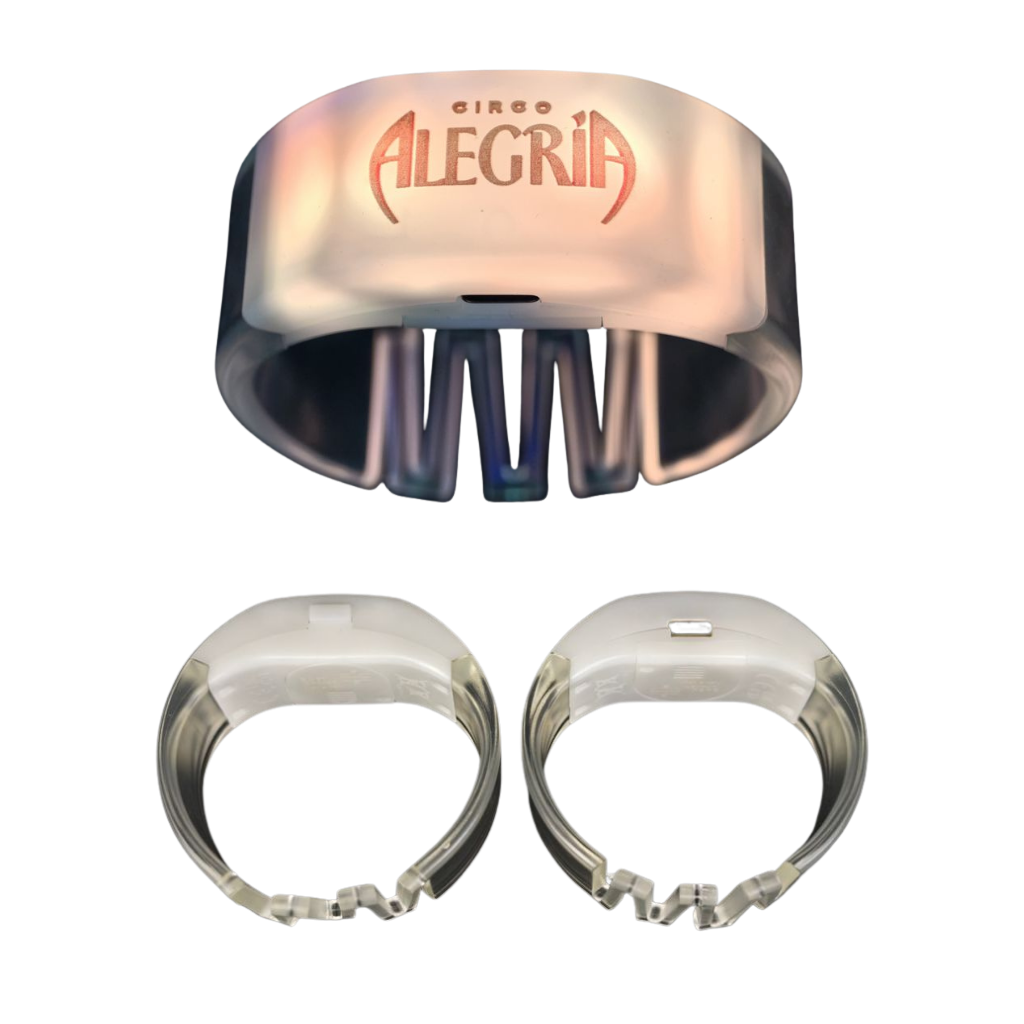
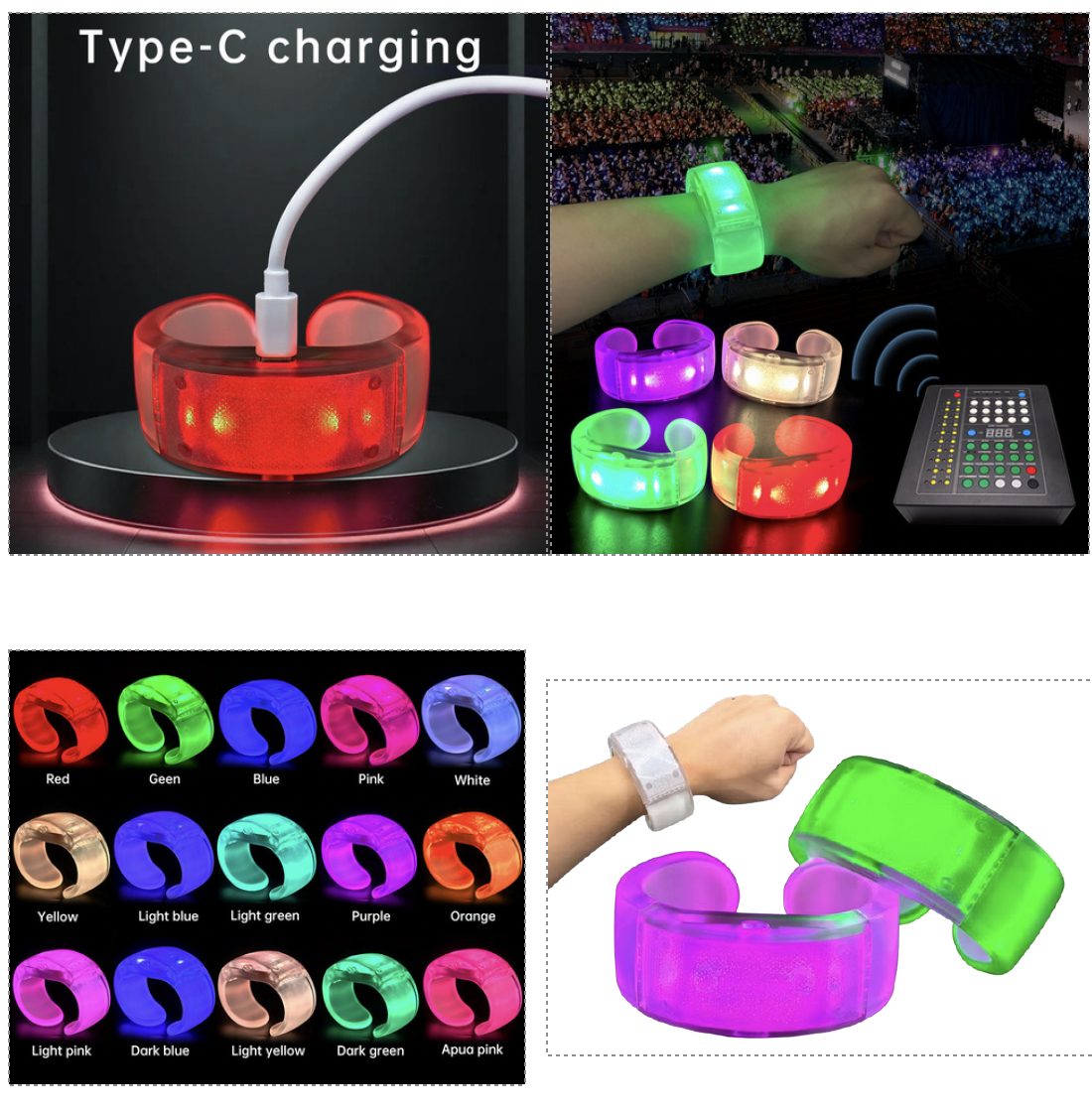
A battery LED wristband is a consumable. A rechargeable one is equipment, and that single difference changes the arithmetic completely once you run more than one event.
Charge over USB-C, use, charge again. There is no cell to replace across five thousand bands, no disposal, and after the second show the higher unit price has already paid for itself.
| Battery models | Rechargeable | |
|---|---|---|
| Power | Button cell or AAA, replaced | Internal cell, charged over USB-C |
| Colours | 15 preset modes | 256 colours with full software integration |
| Control | RF and DMX | DMX512 and RF, app version on request |
| Reuse | Practically single-event | Fleet, used across a season or a tour |
| Cost logic | Per event | Per fleet, falling with every show |
The bands are the easy part. What decides whether a rechargeable fleet works for you is the overnight turnaround: bands come off the crowd, go into charging cases in batches, and are back out the next day. We quote the cases alongside the bands rather than after, because a fleet without a charging plan becomes a room full of dead wristbands on day two.
From a festival floor a crowd reads as one colour at a time, so a wide palette is close to invisible. In a brand activation it is the whole point: the difference between roughly your blue and your actual Pantone, reproduced across ten thousand points of light. Choose the specification against which of those two you are doing.
If the event is a single night and the bands will not come back, the battery-powered RF and DMX models cost less than half as much and do the same job for that one evening.
When the bands are used more than once. A battery band is a consumable: every show needs a new set, or someone spends a day replacing five thousand cells. A rechargeable band is equipment: charge it, use it, charge it again. On the second event it has already paid the difference, and on a tour it is not close.
Three things. The power source is an internal cell charged over USB-C. The colour palette is 256 colours with full software integration rather than 15 preset modes, so gradients and precise brand colours are possible. And an app-controlled version is available on request, which helps smaller productions with no lighting desk.
On charging bases that take 50 bands at a time and charge them in about 2 hours, which is how touring productions handle it: bands come off the crowd, go onto the bases in batches, and are back out the next day. We quote the bases alongside the bands, because the logistics of charging is the part that decides whether a rechargeable fleet actually works for you.
About 2 hours to charge. Use per charge depends on the colour: about 4-6 hours in white and 6-12 hours in single colours such as red. The built-in battery is rated for about 600 charge cycles, with an expected lifespan of about 3 years, and it is covered by the 2-year warranty.
About 400 m with clear line of sight. Place the transmitter high and in view of the audience, not inside a flight case, and test on site in large or closed venues. One controller runs any number of bands.
The controller can lock the button on the band, so guests cannot change their colour during the show.
Yes, in normal rain. Our standard and rechargeable bands are rated IP65, which means protection against splashing water. Full performance in continuous heavy rain cannot be guaranteed, and the bands should not be submerged.
For a festival, not much. From the floor a crowd reads as one colour at a time. For a brand activation it matters a lot, because it is the difference between “roughly your blue” and your actual Pantone across ten thousand points of light.
On DMX, yes. Both respond to the same universe, so a rechargeable core fleet plus battery bands for overflow is a normal setup. Colour matching between the two is approximate, so keep them in separate zones rather than mixed through the same block of seats.
From 100 pieces, about three to four weeks from approved artwork. Because these are reused, most buyers order a fleet once and top it up rather than reordering every event.
Remote controlled LED wristbands for a synchronised show, rechargeable LED wristbands for multi-day and touring use, sound activated and flashing bands when there is no operator, and the RF and DMX controllers that drive them. Also: LED lanyards, light sticks, LED cups and everything else that lights up.
Production details, prices and delivery dates are confirmed for your order.

Each product is created specifically to meet your unique event needs and brand guidelines.

Sustainable materials are available, incl. recycled and biodegradable wristbands.









Our projects