
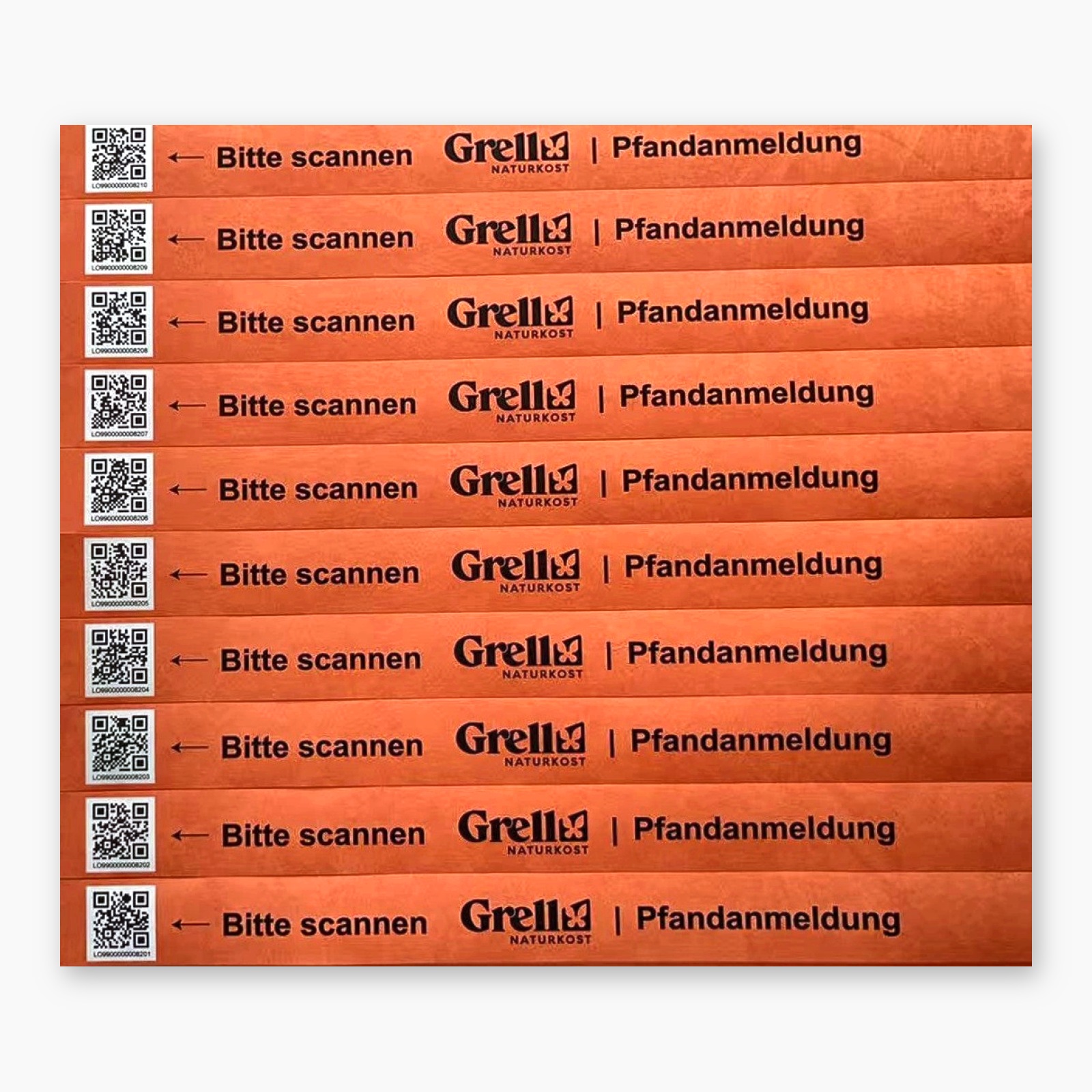
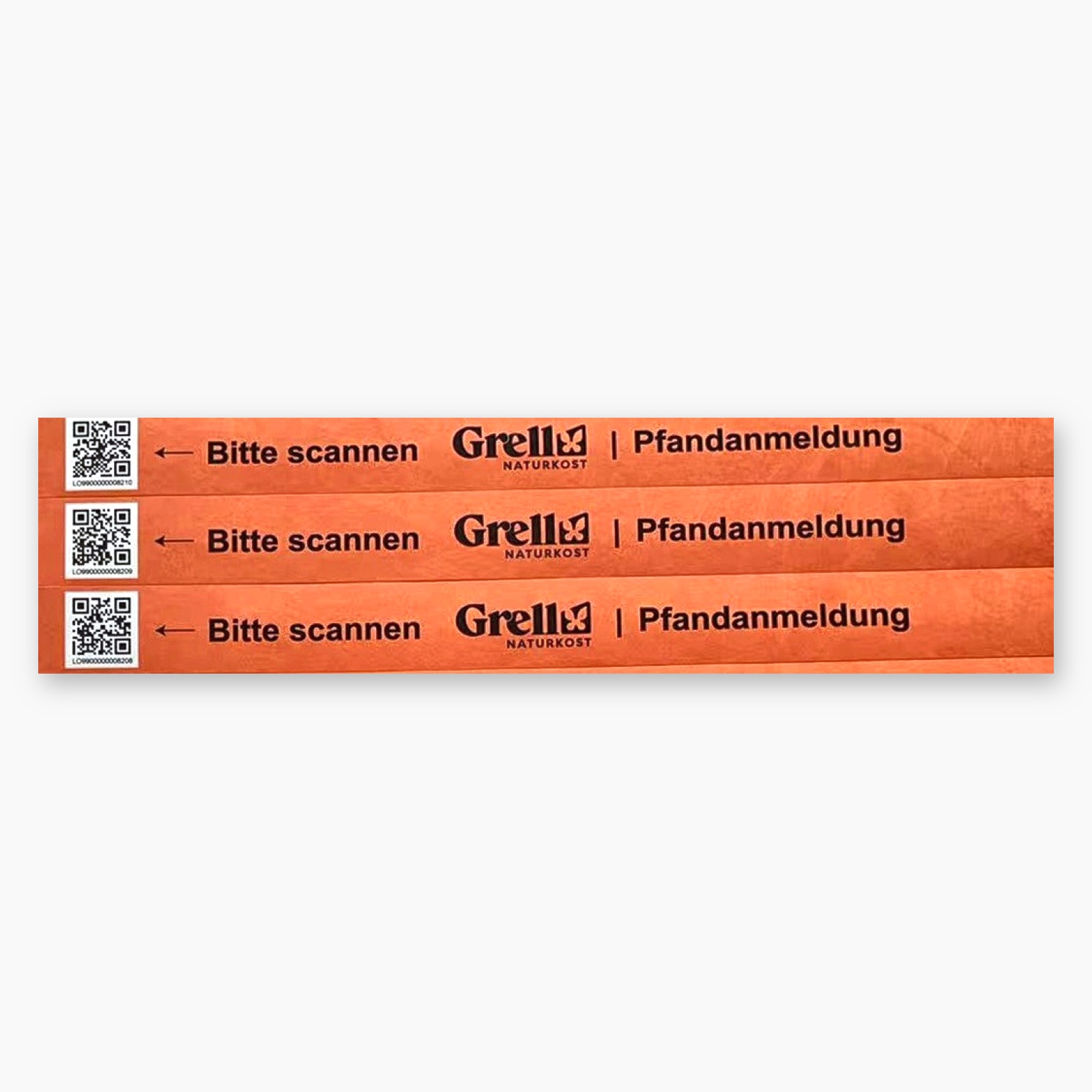
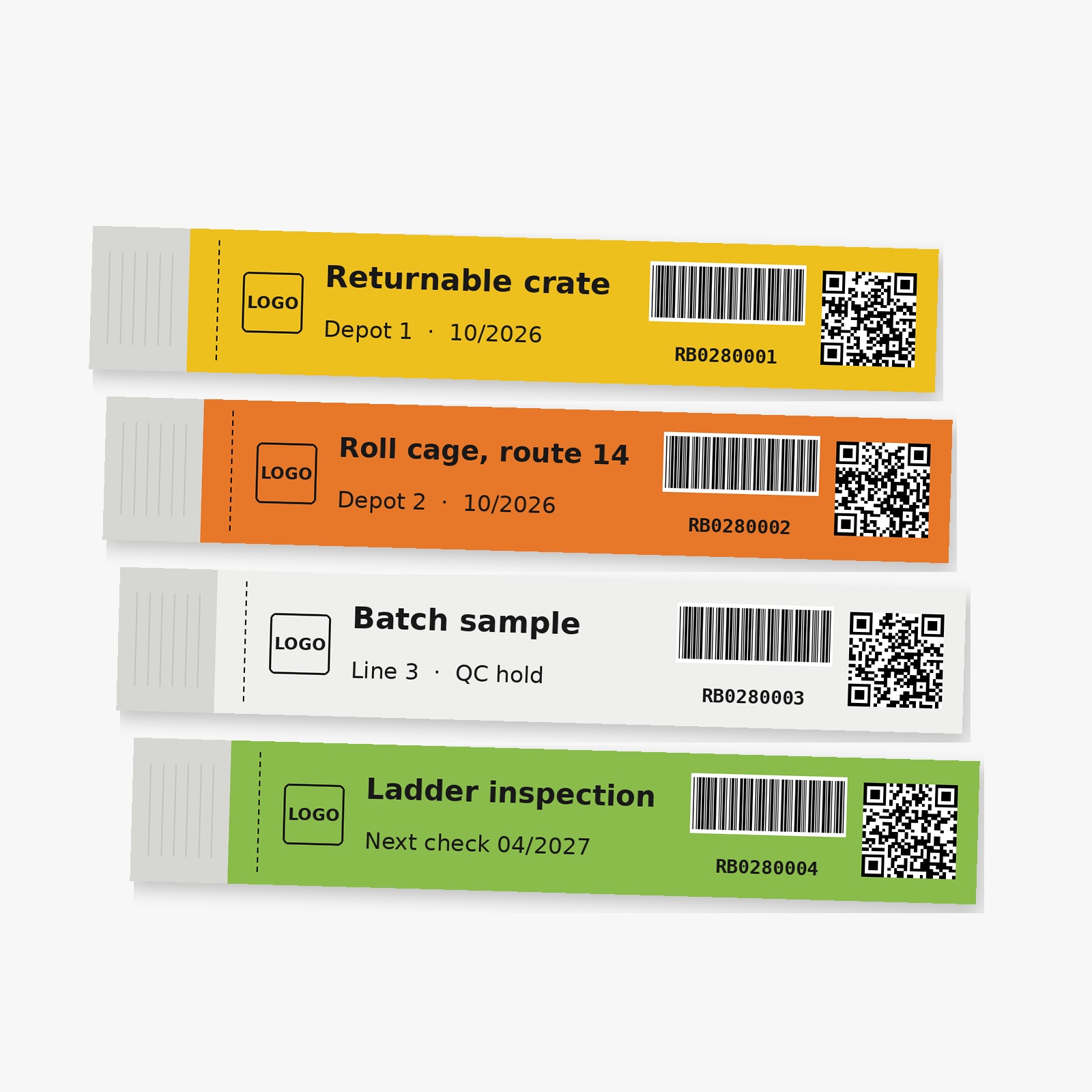
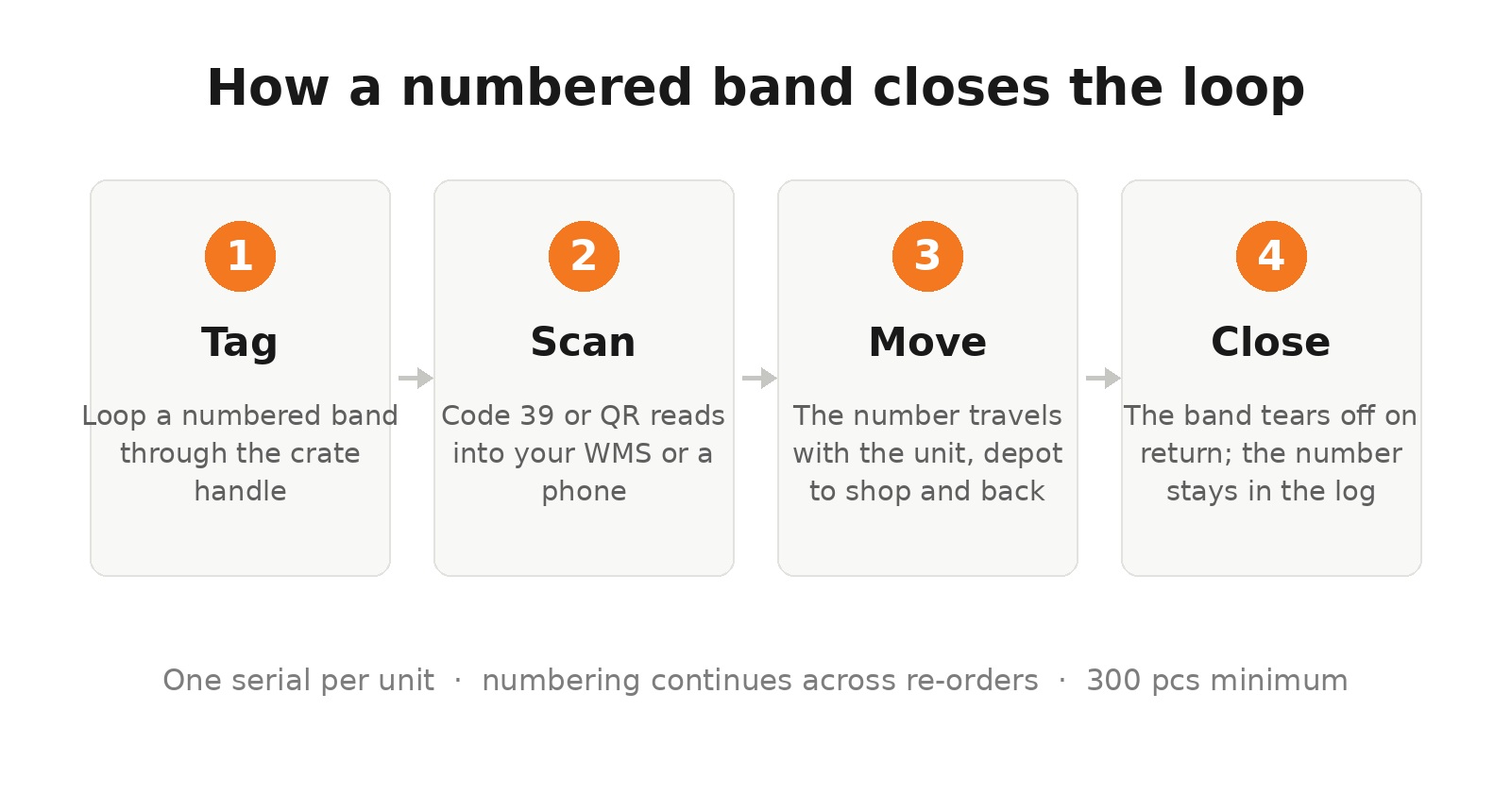
Most Tyvek bands end up on a wrist at a festival. The same material does a quieter job inside warehouses: it is a cheap, waterproof, tamper-evident carrier for a number. Loop one through a crate handle, a roll-cage frame or a sample bag, scan the code, and a physical unit suddenly has an identity your system can read — for a few cents, with no hardware to buy.
Cold stores, condensation, dust, wet produce and textured HDPE all work against adhesive. On a returnable unit there is a second problem: the label has to come off cleanly every cycle, or within a year the crate carries a stack of half-scraped layers that no scanner can read.
A band avoids both. It threads through a handle or around a frame, holds through the trip, and tears off in one movement when the unit comes back. Nothing is left behind, and a band cannot be quietly moved to another unit without destroying itself.
| Code 39 | The safe default for older warehouse systems and industrial handhelds. Alphanumeric, forgiving, widely supported. Takes more width per character. |
| Code 128 | Denser than Code 39, so more characters fit on a 19 mm band. The right choice for longer serials and GS1-style data. |
| QR code | Scans from any phone camera, holds a URL, and keeps working when part of the band is dirty or creased. Best when field staff and drivers do the scanning. |
| RFID | When you need to read a whole pallet without line of sight. That is a different construction — see our RFID bands and hard PVC tags. |
Send us the code content and symbology and we return a scan-tested digital proof before anything is printed.
This is the detail most suppliers get wrong. A numbered run is only useful if the numbers never repeat, and re-orders are where duplicates creep in — the second batch quietly restarts at 000001 and two crates in the yard now carry the same identity.
We record where your last run ended and start the next one from the following number. A customer who finished a batch at RB0280000 gets RB0280001 onwards, years later, without having to ask twice. Prefix, digit count and start value are all yours to set.
If the band takes real mechanical punishment — dragged over steel edges, caught in a roller conveyor — PP compound bands are the tougher alternative in the same format. For plain numbering with no artwork, see numbered plain Tyvek bands; for logo printing without machine-readable codes, 1-colour printed Tyvek. Need a chip as well? RFID Tyvek Wristbands add an NFC inlay to the same single-use band.
You get a digital proof and, on larger projects, physical samples in your own artwork before the run is committed.
Code 39, Code 128 and QR are all available, as is a plain sequential serial number. Pick whatever your existing scanners and system already read — the band is the carrier, not the standard.
No. Sequential numbering continues across re-orders, so a second batch does not create duplicate identities in your data.
Anywhere adhesive gives up — cold stores, condensation, dust, wet produce and textured HDPE — and on returnable units, where a label has to come off cleanly every cycle. The band loops through a crate handle, a roll-cage frame or a sample bag instead. Minimum order is 1 000 pieces, packed 100 per envelope with your text, article number and barcode on the envelope.

Our EU-based production means we meet even the tightest event deadlines.

Each product is created specifically to meet your unique event needs and brand guidelines.

Sustainable materials are available, incl. recycled and biodegradable wristbands.









Our projects