An award is a physical object that says a specific thing happened on a specific day. That is why people keep them for decades — and why the difference between an award that ends up on a wall and one that ends up in a drawer is decided by four or five specification choices that take ten minutes to make and are usually made by default.
First question: is there time to make a die?
Everything follows from this. A custom medal starts with a new die cut to your shape, which is why it needs roughly a hundred pieces to make sense and three to four weeks to produce.
If the event is inside three weeks, or the quantity is under a hundred, that route is closed — and the correct answer is not to compromise on the design, it is to change product. Gold, silver and bronze stock medals are 7 cm, embossed, ship from stock and take laser engraving or an applied full-colour print. They work from 25 pieces, in days. School sports days, club championships and internal recognition almost always belong here, and nothing is lost by admitting it.
Zinc alloy or iron
For a custom medal, this is the first real decision and it constrains the design.
| Zinc alloy | Iron | |
|---|---|---|
| Maximum size | 65 mm | 50 mm |
| Cut-out holes in the design | Yes | No |
| Fine detail | Holds it | Softens it |
| Right for | Complex shapes, corporate awards, premium sport | Large participation runs where unit price decides |
On a two thousand piece race order the difference in feel between the two is smaller than the difference on the invoice. On a fifty piece corporate award it is the other way round.
Then the finish — and this is where photographs are won or lost
Six finishes, and the only question that matters is what the artwork contains.
- Imitation hard enamel — colour filled flush and polished. Smooth, glass-like. Flat brand colours.
- Soft enamel — colour recessed between raised metal lines. Textured, and you can feel it.
- 3D relief, no enamel — pure metal, light and shadow doing the work. Sculptural, no colour.
- Full-colour doming — printed artwork sealed under a clear resin dome. The only affordable way to get a photograph or a gradient onto a medal.
- UV colour print on 3D relief — colour printed directly onto a sculpted surface, following the relief. Colour and texture at once; nothing else does this.
- Standard 50 mm shape — a stock round medal with a full-colour dome, no new die. The fastest and cheapest route to a colour medal.
The single most common mistake: choosing enamel for artwork that contains a gradient. Enamel is filled colour, one flat tone per cell. If the design has a photograph, a gradient or a fade, it has to be doming or UV print, and finding that out at proofing stage costs a week.
The back of the medal is free space
It is also the cheapest thing that makes an award worth keeping. Names, numbers and dates are engraved on the reverse and they can be different on every single piece — supply them as a list, and there is a small per-piece charge but no additional setup.
A medal with a name on it is a personal object. The same medal without one is stock. That is a very large difference for a very small cost, and it is skipped more often than any other option in the category.
The ribbon is a lanyard, and it is half the award
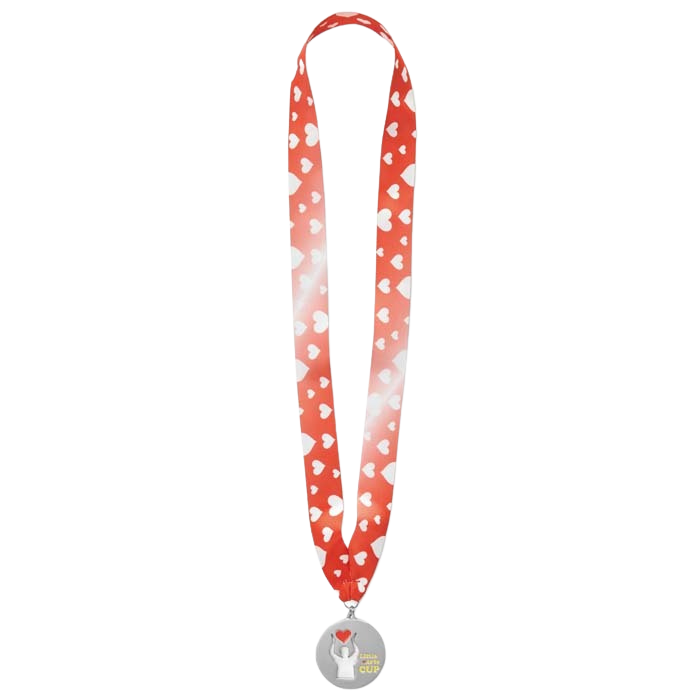
Medals normally come with a polyester neck ribbon, typically around 80–90 cm, and it is treated as an afterthought roughly always. It should not be: it is the part visible when the medal is worn, and it can carry the event name, the year and a sponsor.
The options are the same as on any printed lanyard: up to three colours with a silkscreen logo, or full-colour printing on both sides. Ask whether a recycled rPET ribbon can be run with your order where sustainability is part of the specification — and on a wooden medal it is close to mandatory, because a natural medal on a virgin polyester ribbon undercuts its own argument.
Gold, silver and bronze in one order
The same tooling produces all three, so a single order can include first, second and third place in different platings, each with its own engraved name. This is the normal way competition orders are placed and it does not multiply the setup cost.
One practical note: most events need more bronze than gold. Plan the ratio rather than splitting the order in three.
When the award is not worn
A medal goes round a neck. Some recognition does not belong there — annual awards, partner recognition, employee-of-the-year programmes — and for those the object sits on a desk where colleagues see it every day.
Laser engraved glass trophies come in two sizes that suit two different occasions: a 400 g circular plaque for monthly and quarterly recognition, and a 690 g rectangular block for the annual award and the photograph on stage. Weight is the product here — perceived value in an award tracks weight more closely than any other single property, which is why economising on it is usually a false saving.
The box changes the moment
At a finish line, no: the medal goes straight round a neck and packaging is waste. At a ceremony or a dinner, the presentation box is most of what makes the moment feel formal, and it is what stops the award arriving scratched. The lid can carry your logo, which is the cheapest way to turn generic packaging into event packaging.
A ten-minute specification
- How long until the event? Under three weeks or under 100 pieces means stock medals, not a custom die.
- Does the artwork have a gradient or a photograph? If yes, doming or UV print. Enamel is out.
- Cut-outs or fine detail? Zinc alloy. Otherwise iron is cheaper.
- Will each piece carry a name? It should. It costs very little and it changes what the object is.
- Is it worn or displayed? Worn means a medal and a ribbon worth printing. Displayed means a glass trophy.
- How is it handed over? A ceremony justifies a box; a finish line does not.
The full awards range is here — custom medals, stock medals, wooden medals and glass trophies.