
Search for Tyvek bands and every result is a festival. Entry control, VIP tiers, a photo of a crowd with their hands up. That is where the volume is, and it has quietly hidden a second market from the people who need it most: the logistics manager trying to work out where 4 000 crates went.
The material does not care. A Tyvek band is a waterproof, tear-resistant, tamper-evident carrier for a number that costs a few cents and needs no hardware to deploy. On a wrist it controls entry. Threaded through a crate handle it does asset tracking.
The problem nobody costs properly
Every business that sends out returnable units — crates, roll cages, dollies, pallets, kegs, tool cases — loses some of them. The loss is rarely dramatic. A crate stays behind a shop’s back door, another gets used as a storage box, a third goes out on a route and never comes back. Individually invisible; annually a five-figure line that shows up as “replacement packaging” and gets treated as a cost of doing business.
The reason it stays invisible is that nobody can say which unit went missing, or where it was last seen. The crates are identical. Without an identity per unit there is no shrinkage report, only a stock count that drifts.
Why adhesive labels lose this fight
The obvious answer is a barcode label. On returnable units it fails for three reasons, all boring and all fatal:
- Adhesive does not like the environment. Cold stores, condensation, wet produce, dust and textured HDPE all work against it. A label that lifts at one corner is a label the scanner misses.
- It has to come off cleanly, every cycle. It never does. Within a year the crate carries a laminate of half-scraped labels and the current one cannot be read at all.
- It can be moved. A label peeled off one unit and stuck to another destroys the register silently.
A band avoids all three. It threads through a handle or around a frame with nothing touching the surface, survives the trip, and tears off in one movement on return. The adhesive closure shreds if anyone tries to open and re-use it, so a number cannot migrate between units.
What this looks like in practice
In March 2026 the head of internal logistics at BODAN Großhandel für Naturkost, an organic wholesaler serving independent shops around Lake Constance, Munich and Stuttgart, wrote to us with a simple request: Tyvek bands with a barcode, for a logistics application.
We actually argued against Tyvek at first. Given the mechanical stress we expected, PP compound bands looked like the better fit, and we sent samples of both. The customer tested them and came back with a straight answer: Tyvek held up well enough, and used less material. Two samples, one honest test, decision made.
What went into production was a yellow band carrying a Code 39 barcode, the company logo and a sequential serial. Packed 100 to an envelope, 800 envelopes to the order, with the envelopes themselves printed with the article number and a barcode so the warehouse could book them in like any other stock item. Eighty thousand pieces.
Then the part that matters more than the first order: they re-ordered in July, and again after that, and the request was not “another 80 000” but “please continue the numbering from RB0280001.” Two more organic wholesalers followed — Rinklin Naturkost in Eichstetten and C.F. Grell Nachf. Naturkost near Hamburg — one at 100 000 pieces, both on the same pattern.
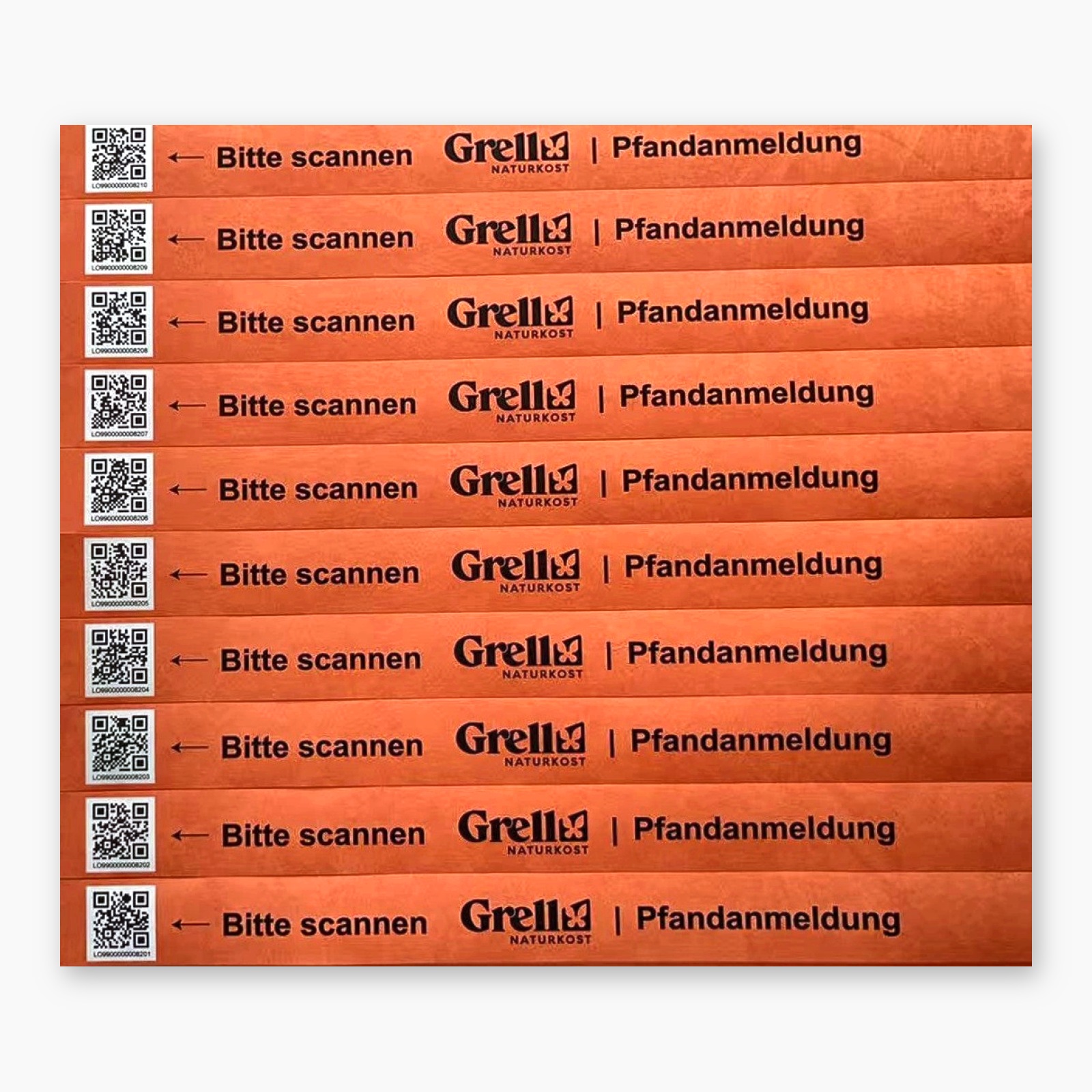
Grell took the idea a step further than internal tracking. Their band reads ← Bitte scannen and Pfandanmeldung — deposit registration. The QR does not point at a website; it simply carries the unit’s own serial number, so the shop receiving the delivery scans it and the deposit is booked against that specific unit. Nothing to install, no equipment on the customer’s side, and the two printed words do the training.
Three houses, roughly a quarter of a million bands a year, all of it running through internal logistics departments rather than marketing budgets.
Getting the numbering right
That re-order detail is the single most underrated part of the whole thing, and it is where most suppliers quietly break the system.
A numbered run only works if the numbers never repeat. Re-orders are where duplicates appear: the second batch restarts at 000001 and now two units in the yard carry the same identity. Every scan after that is ambiguous, and the register that was supposed to fix the problem starts producing nonsense.
The fix is administrative, not technical. Record where the last run ended, start the next one from the following number, and hold that record between orders so the customer never has to ask twice. Prefix, digit count and start value belong to the customer, not the printer.
Choosing the code
| Code 39 | The safe default for older warehouse systems and rugged handhelds. Alphanumeric and forgiving, but wide — fewer characters fit on a 19 mm band. |
| Code 128 | Denser, so longer serials fit. The right pick for GS1-style data or anything beyond about eight characters. |
| QR code | Reads from any phone camera and keeps working when part of the band is dirty or creased. Best when drivers and shop staff do the scanning rather than the warehouse. |
| RFID | For reading a full pallet without line of sight. Different construction and a different price bracket — see RFID bands and hard PVC tags. |
One practical note: whichever symbology you choose, test it on the actual band colour before you commit. Contrast on a saturated orange or yellow base is not the same as on white, and a proof that scans on a desk under good light can struggle on a loading bay at six in the morning.
Nine other places this works
- Roll cages and dollies — colour by route, number by unit, so a yard check is a glance rather than a count.
- Deposit registration — a code the receiving customer scans, so the deposit is booked against the exact unit rather than a line on a delivery note.
- Production batch and retention samples — the band stays legible in a freezer, which paper does not.
- Inspection tags — ladders, harnesses, hoists and portable tools, with the next check date printed beside the code.
- Rental and hire equipment — fitted at check-out, destroyed on removal, so the tag cannot be swapped between items.
- Nursery and horticulture — variety, batch and block on a band that survives a season outdoors.
- Waste and recycling containers — proof of collection per bin, per round.
- Laundry and textile services — bundle identity through wash and transport.
- Field service and job tickets — a scannable number tying a physical item to a work order.
What it costs
At the volumes above, a printed, numbered, barcoded Tyvek band lands in the range of a few cents per piece. Set that against one replacement crate, or against an hour of someone reconciling a stock count by hand, and the arithmetic stops being interesting very quickly.
It is worth being clear about what this is not. It is not a track-and-trace platform, it does not read itself, and it will not tell you where a crate is right now. It gives each unit a cheap, durable, unique identity that your existing scanners and your existing system can read. Most of the value in asset tracking comes from that one step, and it is the step most operations skip because the platform quotes look expensive.
Starting
To quote a run we need the annual quantity, the symbology and what the code should contain, the serial prefix and start number, the base colour, and your logo as vector artwork. You get a scan-tested digital proof, and on larger projects physical samples in your own artwork, before anything is committed.
The product page has the full specification: numbered Tyvek ID bands with barcode or QR code. If your application involves heavier mechanical stress, start instead with PP compound bands — the same idea in a tougher material.